Copper Industry ETF Investment Strategy Report for the Electric Age

Three-Line Summary
Structural increase in electricity use → explosive copper demand
Supply is structurally constrained → long-term shortage
Copper has already broken through to new highs, prices are entering a new phase
Structural Change in Copper Demand in the Electric Age
- Electrification is not just a business cycle but a megatrend spanning decades.
- Global power demand: about +50% by 2040
- U.S.: Stagnant for the past 25 years → now in a growth phase of up to +2.5% a year
- China: An average of +3.2% a year through 2040
- India: An average of +4.2% a year
- Copper is essential across the entire process of power generation, transmission and use.
In other words, more electricity use = more copper use.
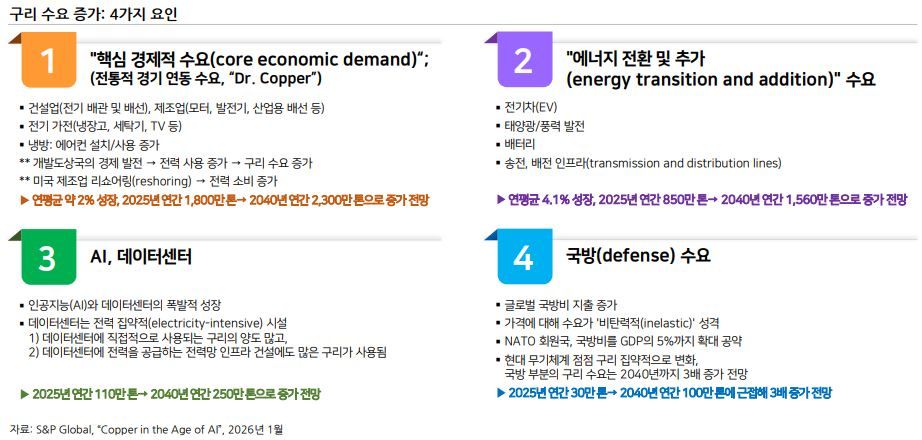
The Four Pillars of Growing Copper Demand
① Traditional cyclical demand
Construction, manufacturing, home appliances, cooling
Growth in developing countries + reshoring
18 million tons in 2025 → 23 million tons in 2040
② Energy transition demand
Electric vehicles, solar and wind power, batteries
Investment in transmission and distribution infrastructure
8.5 million tons in 2025 → 15.6 million tons in 2040
③ AI and data center demand
A power-intensive industry
Both the servers themselves and the power grid use copper
1.1 million tons in 2025 → 2.5 million tons in 2040
④ Defense demand
Rising defense spending + price-inelastic demand
Rising copper intensity of modern weapon systems
300,000 tons in 2025 → 1 million tons in 2040
Supply Cannot Keep Up: A Structural Shortage
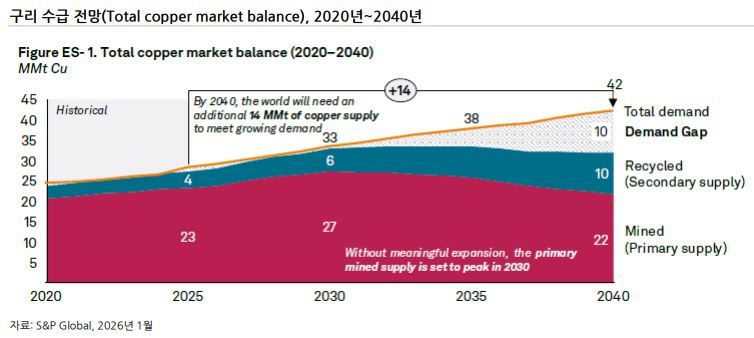
Global copper demand
28 million tons in 2025 → 42 million tons in 2040
Without new mines or expansions
Mined supply: Peaks in 2030 (27 million tons) and then declines
Falls to around 22 million tons in 2040
Even accounting for recycling
👉 An annual supply shortfall of about 10 million tons in 2040
👉 A 36% shortfall relative to 2025 demand
The IEA also
warns that "existing and planned mines alone will meet only 70% of demand in 2035."
What is the IEA?
IEA = International Energy Agency → International Energy Agency
An organization that serves as the global 'reference point' for energy
- Demand and supply outlooks for power, oil, gas, nuclear and renewable energy
- Presents energy transition (decarbonization, electrification) scenarios
- Publishes official statistics and warning reports referenced by governments and global companies
👉 The IMF + OECD + Statistics Korea of energy
Prices Are Already Responding
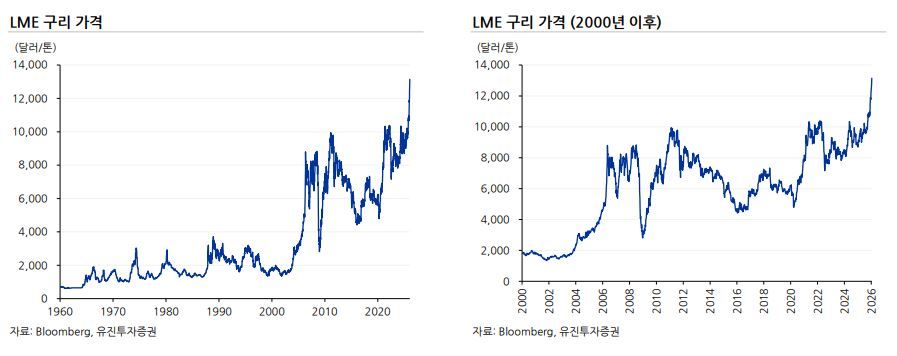
- LME copper prices break through 10,000 dollars per ton
- Above previous highs → entering a new price level
- A short-term correction is possible, but
→ the long-term electrification trend remains intact
Investment Method ① Physical Copper ETF
TIGER Copper Physical ETF
- Physical copper securities + copper ETFs + a small amount of futures
- No currency hedging
- Can be invested in through pension accounts
- Total expense ratio 0.83%
👉 A pure bet on copper prices
Investment Method ② Copper Producer ETF
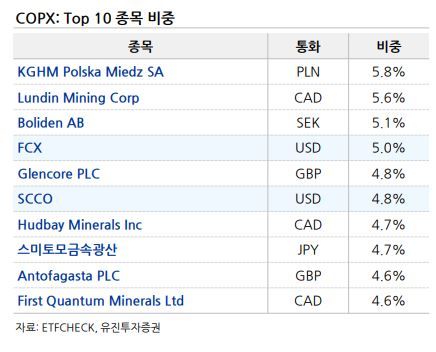
COPX (Global X Copper Miners ETF)
- Holds about 50 global copper producers
- Major holdings: FCX, SCCO, etc.
- Leverage effect when copper prices rise
Freeport-McMoRan(FCX)
- Current dividend yield about 1%
- Based on past cases
- Dividend yield range of 1.5~2% → buying opportunity
Rising copper prices →
① Improved earnings → larger dividends
② Or greater appeal if the stock price corrects
Cable Companies: Quiet Beneficiaries
- Cable companies have copper price-linked clauses
- Rising costs → can be passed on to selling prices
- Recent quarters - high earnings growth, limited valuation burden
👉 Power equipment and cable stocks are indirect beneficiaries of rising copper prices
ETF Strategy Summary
- Short term: Approach in installments given price volatility
- Medium to long term: Electrification, AI, defense → structural demand
- Within a portfolio: A strategy combining physical copper + producers is effective