China's Phased Reduction of Export Tax Rebates: A Policy Signal for Restructuring the Battery Industry
A clear will to control supply
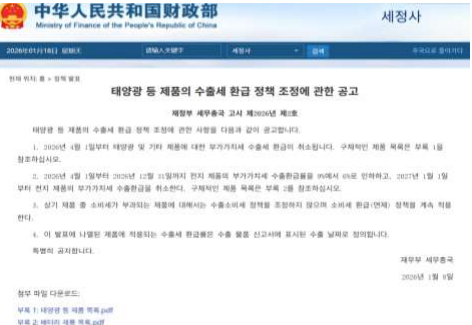
The Chinese government has formalized the reduction and abolition of export value-added tax (VAT) rebates for the solar and battery industries.
The key points are that for solar, rebates will be fully abolished from April 2026, and for batteries, the rebate rate will be cut from 9% → 6% and then fully abolished in 2027.
This measure is not a one-off policy,
- March 2025: management of debt ratios at EV makers
- 3Q25: suspension of mining at Zangge Mining and CATL mines
- November 2025: battery export controls (1-year grace period)
but is judged to be an extension of the Chinese government's consistent stance on supply control, as seen in measures like these.
There is a clear will to clean up the battery factories that proliferated under local government leadership in the past and reorganize the industry around top companies that can survive without subsidies.
Fiscal soundness + response to trade friction
The policy has two main purposes.
- First, fiscal soundness.
Export tax rebates are effectively a structure in which the Chinese government pays subsidies to overseas automakers. Reducing and abolishing the rebates is expected to stop fiscal leakage and naturally weed out marginal companies that had been surviving on low-priced orders.
- Second, a preemptive defense against external trade friction.
Regarding the overcapacity and subsidy controversies that the U.S. and Europe have continuously raised, the Chinese government can secure the justification that it is adjusting production capacity on its own. This is interpreted as a move to keep key companies such as CATL and BYD from becoming direct targets of unfair-subsidy sanctions in the future.
Front-loaded exports + strong lithium prices
In Q1 2026, an increase in front-loaded exports from China and strong lithium prices are likely to occur at the same time.
- When the battery export rebate rate is cut from 9% → 6% starting in April 2026, Chinese battery makers' export OPM will immediately fall by 3%p.
Because this level is directly tied to survival for small and mid-sized companies with low margins, moves to maximize rebates by shipping before the effective date are inevitable.
- The reason the government set a grace period until the end of the year is also interpreted as a measure to prevent a supply gap caused by the abolition of rebates and to buy time for negotiations on passing price increases through to existing long-term contracts.
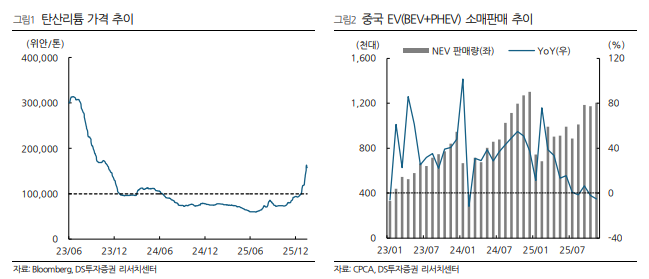
- Meanwhile, lithium prices are expected to stay strong through the first half.
Considering the administrative procedures following the environmental impact assessment notice on December 19, 2025, CATL's Yichun mine is likely to resume operations in mid-February 2026. Given profitability secured at 80,000~100,000 yuan or more per ton and the need to respond to front-loaded exports in April, there is ample incentive to restart. However, given the government's stance of avoiding oversupply, full operation right after the restart is unlikely, so strong lithium prices are likely to continue through the first half.
Structural windfall for Korean companies
For non-Chinese battery makers, especially Korean companies, an opportunity to expand market share is expected to open up from 2Q26.
- The key is reduced supply and a structural narrowing of the price gap.
Behind Chinese batteries being 15~20% cheaper than Korean ones was an export rebate benefit of as much as 9~13%. Once rebates are reduced or abolished, Chinese companies will inevitably have to raise prices by the amount of the lost subsidy.
- In the short term, it will be difficult for Korean companies to secure a price advantage, but ultra-low-price dumping strategies like those of the past become structurally impossible.
In terms of timing, the supply reduction effect from the depletion of inventory in China is expected to become visible from 2Q26, and after the complete abolition of rebates in 2027, the narrowing of the price competitiveness gap due to Chinese companies' rising cost burden is likely to be clearly confirmed.
Summary
Short term (Q1 '26): front-loaded exports from China, strong lithium prices
Medium term (Q2 '26~): reduced Chinese supply, easing price competition
Long term (2027~): Korean battery makers enter a phase of structural competitiveness recovery
This policy is judged to be an event where the focus should be on medium- to long-term changes in industry structure rather than short-term volatility.