[2026 Bio Investment Report] Big Pharma Turning Crisis into Opportunity, and the Technologies That Make Money
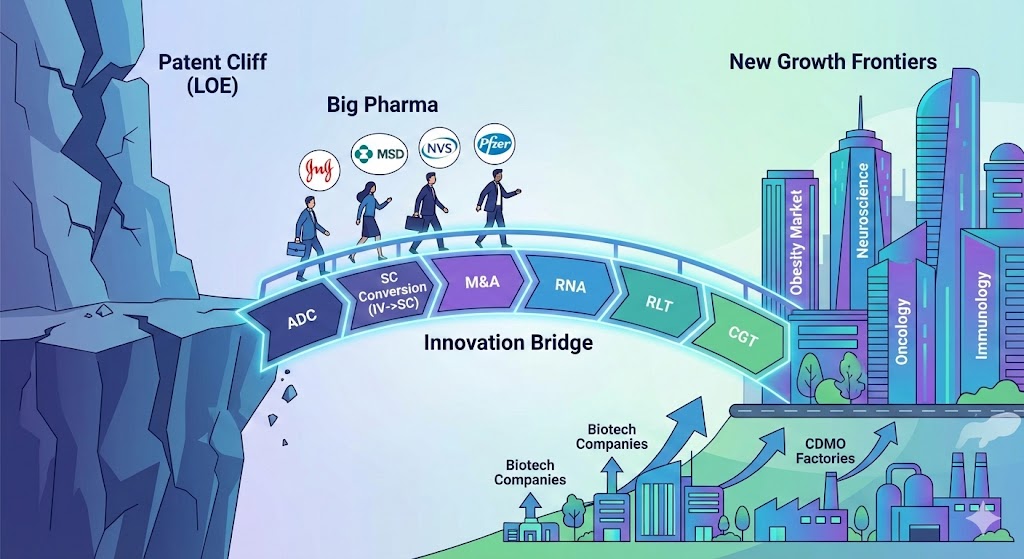
Key takeaways from the J.P. Morgan Healthcare Conference & analysis of promising next-generation technologies
Market overview: "The dark clouds have cleared, and wallets have opened"
In a word, the mood at the 2026 J.P. Morgan Healthcare Conference was "relief and anticipation side by side."
- Uncertainty resolved: Policy risks such as tariffs and drug price cuts (IRA) have been resolved through agreements with the Trump administration and other measures. "Uncertainty," which the stock market hates most, has disappeared.
- New markets exploding: Beyond cancer drugs, huge new markets in obesity and brain diseases are opening up, and companies have raised their growth targets.
- Technological progress: Going beyond simple new drug development, technologies that deliver drugs better (ADC) and make them easier to administer (SC) are translating into real revenue.
Key strategies of the big four pharma companies
Global pharmaceutical companies have each declared, in their own way, that they will go beyond survival to growth.
- J&J (Johnson & Johnson): "Stepping on the accelerator." Targeting 60 trillion won in cancer drug sales alone. Defending against political risk by investing in U.S. plants.
- Merck (Merck): "The god of defense." Defending against the patent expiration crisis with a "switch to injectable formulation (SC)." Focusing on developing new drugs targeting women's cancers.
- Novartis (Novartis): "The tech geek's big bet." Going all in on 3 next-generation platforms: RNA, radioligand therapy (RLT) and cell and gene therapy (CGT).
- Pfizer (Pfizer): "A spectacular comeback." Attempting a turnaround by filling the gap left by COVID revenue with "obesity treatments" and large M&A deals.
Technologies attracting money: ADCs & bispecific antibodies
Here is an easy-to-understand explanation of the two technologies investors should watch most closely, which big pharma companies are spending huge sums to buy.
① ADC (antibody-drug conjugate): a "guided missile" that targets only cancer cells
Conventional cancer drugs (carpet bombing): In trying to kill cancer cells, they also attack normal cells, causing hair loss and vomiting.
Features of ADC technology (precision strike)
- Antibody: A navigation system that seeks out only cancer cells.
- Drug: A powerful bomb (the cancer drug).
- Linker: The string that firmly ties the antibody and the bomb together.
- How it works: The antibody finds a cancer cell and latches onto it, then slips inside the cancer cell and detonates the bomb only there.
- Investor perspective: It is effective with few side effects. This is why Merck (Merck) and Pfizer (Pfizer) have recently been racing to secure ADC technology, and companies with "linker" technology and ADC manufacturing plants (CDMOs) benefit.
② Bispecific antibodies: "handcuffs" with two hands
Conventional antibodies: With one hand, they grabbed either only cancer cells or only immune cells — just one of the two.
How bispecific antibodies work (a forced meeting): The Y-shaped antibody uses both hands.
- Left hand: Grabs the cancer cell by the collar.
- Right hand: Takes the hand of the body's police force, the "immune cells (T cells)."
- How it works: It drags immune cells that were far away right next to the cancer cell and forces a fight, saying, "This is the enemy, attack!"
- Investor perspective: It works well even in patients who have developed resistance to existing drugs, so it is considered a next-generation blockbuster technology. J&J is actively using this technology to treat multiple myeloma.
Survival strategy: the magic of getting past the "patent cliff"
The way big pharma companies overcome the crisis of revenue dropping to 0 won when patents expire after 20 years (the patent cliff) is very clever.
① Formulation change (IV → SC): "Turning an inconvenient must-visit restaurant into a delivery favorite"
- Situation: The 20-year monopoly ends and generic copies (knockoffs) flood the market.
- Strategy: An injection (IV) that requires being admitted to a hospital for a 2-hour drip is changed to an injection (SC) that can be given in 5 minutes near home.
- Effect: Patients choose the convenient original (SC) over an inconvenient generic, even if the generic is a bit cheaper. With this technology, the drugmaker secures new patents and extends its exclusivity period. (Merck's Keytruda strategy)
Beneficiaries: Companies with enzyme technology that turns intravenous injections into subcutaneous injections (Alteogen, etc.).
② Aggressive M&A: "Recruiting rookie idols"
- Strategy: Worried that in-house development would take 10 years, they use money to acquire biotechs whose technology has already been proven.
- Effect: They secure pipelines that can generate revenue as early as next year. This is a positive signal that gets money circulating throughout the entire bio ecosystem.
The real reason the "patent cliff" happens after 20 years
The moment the promised 20 years are up, the shield disappears.
Anyone can copy it: Other drugmakers look at the already-published blueprint and make the same drug (a copy).
For chemically synthesized drugs, these are "generics" (exactly identical copies)
For biologics, these are "biosimilars" (copies with similar efficacy)
Price collapse: If the original drug cost 1,000,000 won, the copies are released at 500,000 won or 300,000 won.
Revenue plunge (cliff): Naturally, patients and hospitals use the cheaper drug with the same efficacy. So the original drugmaker's revenue drops vertically, as if falling off a cliff. This is the "patent cliff."
Put simply, when a company launches a new drug or develops a product and files a patent, it discloses the secret recipe or blueprint to the world. It provides the information so that other scientists can refer to it for the advancement of the bio industry
Others can look at it to apply it or conduct research, but they cannot make an identical product and sell it, and the government protects this for about 20 years. After that, others can use it in exactly the same way.
It is easy to understand if you think of another restaurant selling a famous restaurant's recipe exactly as is, at a lower price.
Conclusion and investment points
The bio market now is in "a period when the winter of policy is ending and the spring of technology is arriving."
- Don't look only at big pharma: Pay attention to the technology companies (ADCs, bispecific antibodies, SC formulation changes) that big pharma is going shopping for with bags of money.
- Manufacturing facilities (CDMO): Once a new drug is developed, someone has to make it. As the U.S. excludes China (BIOSECURE Act), CDMO companies in Korea and elsewhere are expected to benefit indirectly.
- Check the numbers: The real deal is not companies riding mere expectations but those producing actual clinical data and technology transfer agreements (Deals).
Related companies
Global big pharma (leading stocks driving the market)
These are the stars of the J.P. Morgan Healthcare Conference. They lead the market with stable portfolios and enormous financial firepower.
- Johnson & Johnson (JNJ): Declared accelerated growth through 2030. A powerhouse in cancer drugs and medical devices.
- Merck & Co. (MRK): Maintaining its dominance in cancer drugs through the Keytruda SC switch and ADC acquisitions.
- Novartis (NVS): A technology-focused drugmaker that has gone all in on 3 platforms: RNA, RLT and CGT.
- Pfizer (PFE): A traditional powerhouse aiming for a turnaround with obesity treatments and cancer drugs.
- Eli Lilly (LLY): (Added beyond the report) The absolute leader in the obesity treatment market.
- Novo Nordisk (NVO): (Added beyond the report) A company splitting the obesity market with Wegovy/Ozempic.
SC formulation change (the key to defending against the patent cliff)
These are technology companies that are key partners in Merck's "Keytruda SC" strategy and help big pharma defend their patents. This is the sector most certain to benefit.
- Halozyme Therapeutics (HALO): The originator of global SC formulation technology.
- Alteogen (196170): A company with technology for switching Keytruda to SC, highly likely to sign an exclusive contract with Merck (MSD). One of Korea's leading bio stocks.
ADCs & bispecific antibodies (technologies big pharma is buying)
These are fields where big pharma aims for "technology licensing (L/O)" or "acquisitions (M&A)" rather than in-house development. Companies with proven technology are the targets.
- Daiichi Sankyo (DSNKY): The Japanese company that conquered the global ADC market with "Enhertu." (U.S. OTC/Japan)
- Viking Therapeutics (VKTX): Developing obesity and NASH treatments; frequently mentioned as an M&A candidate. (U.S.)
- LigaChem Biosciences (141080): (Formerly LegoChem Biosciences) Holds world-class ADC linker technology. Many past technology transfers to big pharma. (Korea)
- ABL Bio (298380): Holds a bispecific antibody platform (Grabody-B). Drawing attention for its blood-brain barrier (BBB) penetration technology. (Korea)
- Orum Therapeutics (400840): (Assuming it is listed; verification needed if unlisted) Holds next-generation technology combining TPD (targeted protein degradation) and ADCs. (Korea)
CDMO (trickle-down effect: the factories that will make the drugs)
These companies benefit indirectly as big pharma's new drug development increases and Chinese companies (WuXi Biologics, etc.) are excluded under the BIOSECURE Act.
- Lonza (LZAGY): The world's largest bio contract manufacturer. (Switzerland/U.S. OTC)
- Samsung Biologics (207940): The global No. 1 CDMO, receiving love calls from big pharma thanks to its overwhelming production capacity (CAPA). (Korea)
- ST Pharm (237690): A global manufacturing powerhouse for the key raw material (oligonucleotides) of the "RNA" therapies emphasized by Novartis. (Korea)
- Prestige BioLogics (334970): Targeting niche markets as a small-to-mid-sized CDMO. (Korea)
5. Obesity/metabolic diseases (the next big thing)
This is a field Pfizer has entered and whose market size is growing to the 200 trillion won range.
- Hanmi Pharmaceutical (128940): Has an obesity/metabolic disease pipeline (efpeglenatide, etc.) and a history of technology transfer to Merck. (Korea)
- Peptron (087010): Holds long-acting Smart Depot technology (related to once-a-month injectable formulations). Technology transfer talks with global drugmakers are anticipated. (Korea)
This report is reference material compiled from the articles and market data shared with us, and please note that responsibility for investment lies with the investor.