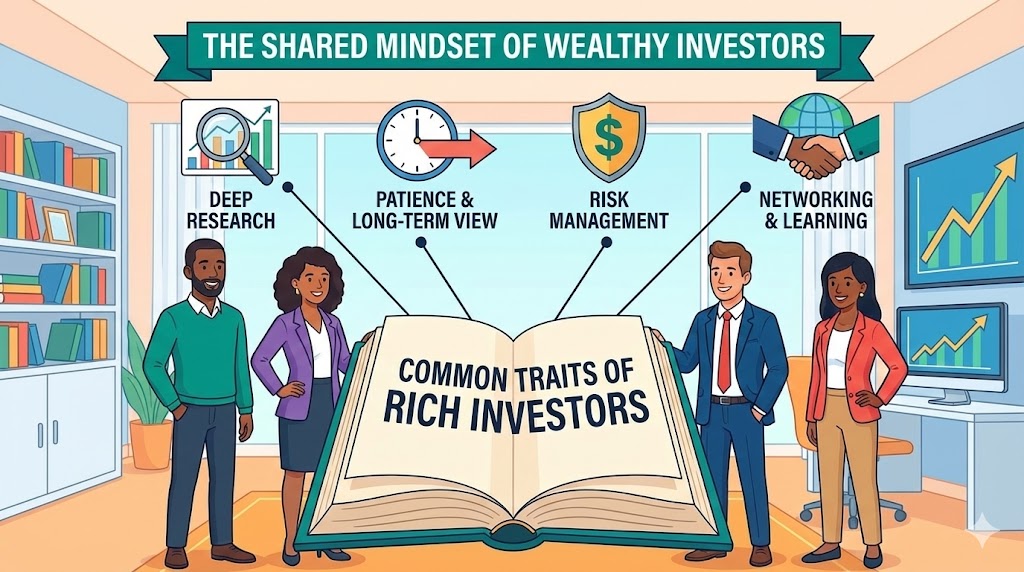
4 Things the Rich Who Made Over 10 Billion Won from Investing Have in Common
"Why do even smart doctors and lawyers go broke in the stock market?"
The answer to this age-old question can be found in an anecdote about Isaac Newton, one of the greatest geniuses in human history.
The man who discovered the law of universal gravitation invested in South Sea Company stock and lost his entire fortune, worth billions of won in today's money.
He later left these words.
"I could calculate the motions of the heavenly bodies down to the centimeter, but I could not calculate the madness of people."
Newton's failure points to a clear fact. Investing is not a matter of intelligence but a matter of temperament and attitude.
The super-rich who beat the market and gained financial freedom: what was different about them? Their formula for success contains 4 pieces of DNA hidden behind the charts and financial statements.
.jpg) 1. The Ability to Know Your Own Ignorance: The Power of 'Metacognition'
The biggest characteristic of failing investors is the arrogance of believing they can predict the market. Convinced that "the stock will go up tomorrow" or "this is the bottom," they take on excessive leverage.
Successful investors, on the other hand, have an outstanding metacognitive ability to view their own abilities objectively. As Warren Buffett said, they clearly know their circle of competence and do not bet on anything outside it.
They do not try to predict the market; they respond to it. Instead of "the stock will go up," they draw up scenarios: "If the stock rises, I'll respond with Plan A; if it falls, with Plan B." Because they acknowledge their own ignorance, they are always humble, and this humility becomes the starting point of risk management.
.jpg) 2. The Patience to Control Dopamine and Endure Boredom
Legendary investor George Soros said, "If investing is entertaining, if you're having fun, you're probably not making any money. Good investing is boring."
Many individual investors consume investing like entertainment. They check stock quotes every day, releasing dopamine with every rise and fall. But wealth is built through the boring magic of compounding.
Successful rich people understand that assets need an absolute amount of time to grow. With the mindset of a farmer waiting for the rice to ripen, they ignore market volatility and quietly wait until a company's intrinsic value is reflected in its price.
When others sneer, "You're still holding that stock?", only those who have endured the boredom get to enjoy the sweet fruit all to themselves.
 3. The Courage of 'Contrarian Thinking' to Walk Against the Crowd
Humans instinctively want to belong to the herd. In the stock market, too, the crowd cheers and buys when prices rise and sells in panic when they crash. But the rich are 'contrarians' who go against this instinct.
Howard Marks called this second-level thinking. When others are dumping stocks in panic, they press the buy button, saying "now is the cheapest it will be," and when others are drunk on greed, they quietly leave the market.
This is not mere bravado. It is a thoroughly rational judgment that takes advantage of the 'price distortions' that occur when crowd psychology tilts to one side. They are not afraid of being alone, and they have a strong mentality that is not swept up in herd psychology.
.jpg)
4. An Obsession with 'Not Losing'
Warren Buffett's first rule of investing is "Never lose money." His second rule is "Never forget rule No. 1."
Rather than 'how much can I make,' the rich first calculate how much they could lose in the worst case. That is because they know better than anyone the mathematical trap that if you suffer a 50% loss, you need a 100% return to recover your principal.
That is why they do not go 'all in.' They spread risk through asset allocation and maintain a cash position to secure a margin of safety that lets them survive even in a crisis. For them, investing is not a gamble aimed at hitting the jackpot, but a defensive battle to protect and grow their assets.
.jpg)
In Closing: Investing Is a Mirror That Reflects You
In the end, investment success depends more on the investor's own character than on stock selection or trading techniques. The market constantly provokes our greed and fear and puts us to the test.
If you are not satisfied with your account right now, it is time to look back and ask whether you acted too clever, whether you gave in to boredom and traded impulsively, or whether you got swept along following others.
People who became rich through investing do not have special superpowers. They are simply people who know how to govern their own desires, keep their principles, and make time their ally. Successful investing is not a technique but a philosophy.